

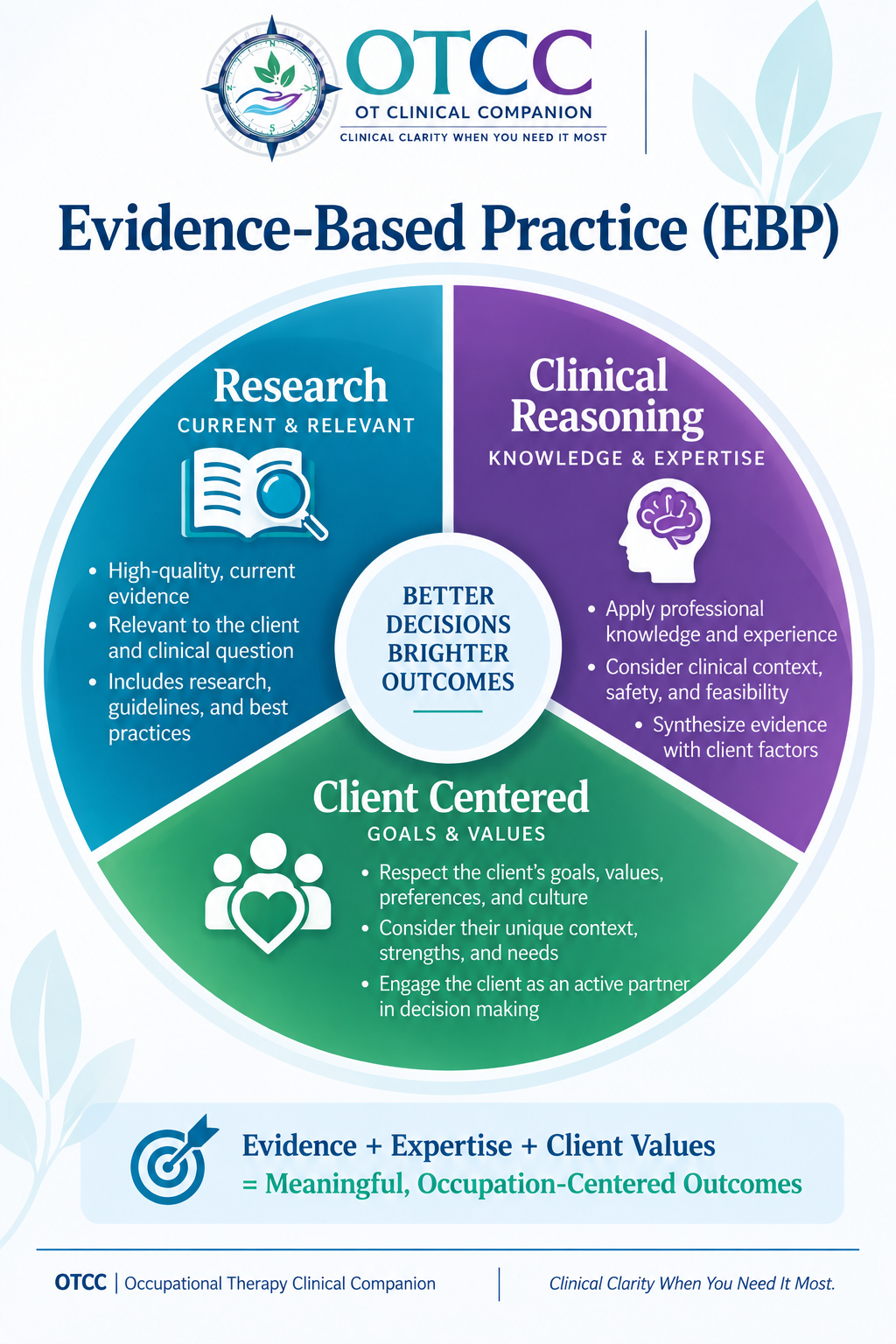
Evidence Based Practice (EBP) Resources
NOTE:
Artificial Intelligence (AI) is used in various elements of the site for image generation and content organization. However, ALL content is reviewed and verified by an OT student, practicing OT and/or OT Faculty.
If you find any errors or have any concerns regarding accuracy please contact us using the form located in the about section. This tool is designed to support the OT profession and your valuable feedback is vital to making that happen.
Resources that help guide us:
• AOTA Resources- journals, podcast, evidence exchange + more
• Textbooks & Specialty Textbooks (such as Dirette or Pedretti, Hand and UE Rehab, etc.)
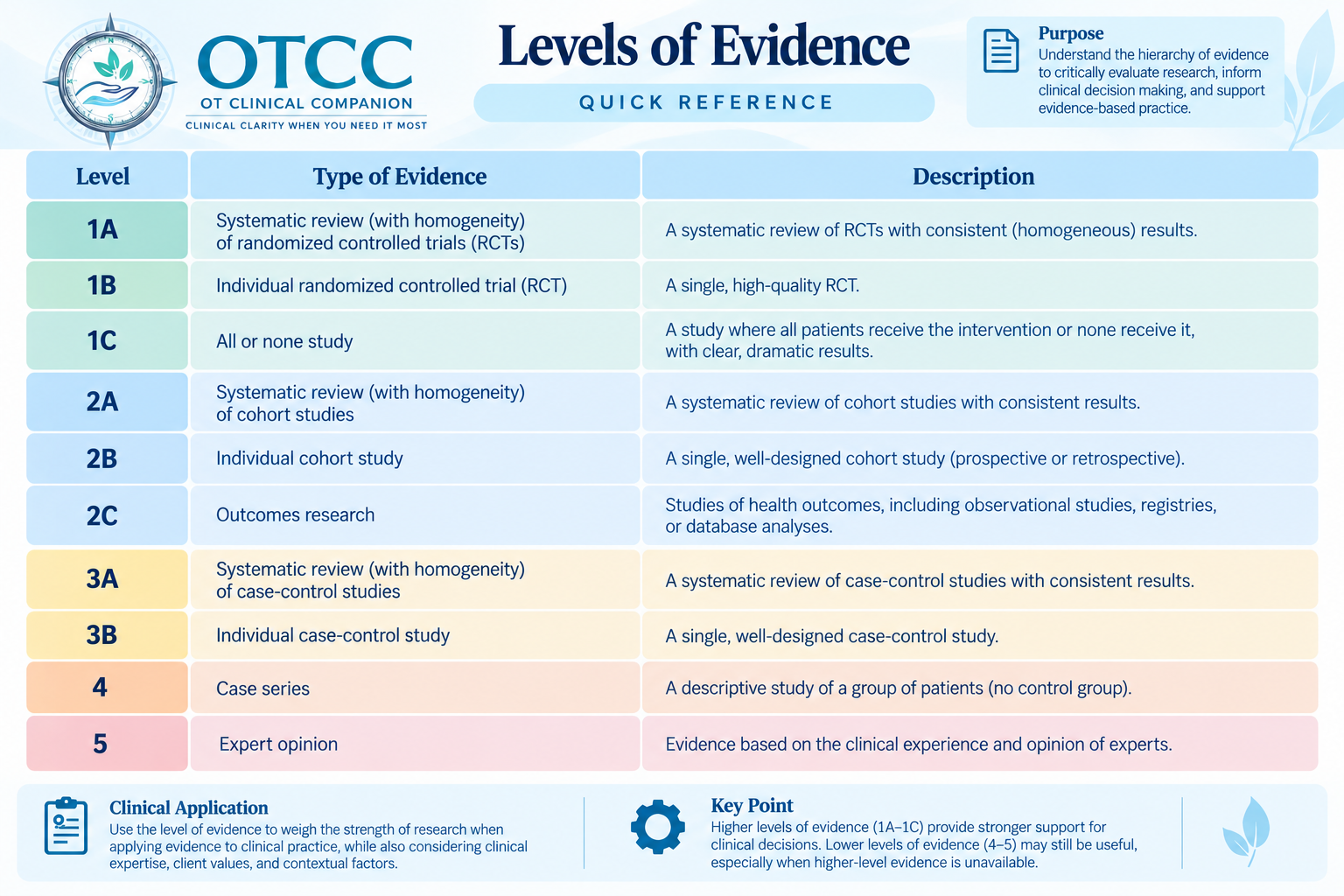
• Peer Reviewed Journal Articles (systematic review focused)
• National Foundations, National Society’s, NIH Institutes, CDC, etc.
• Clinical Practice Guidelines (such as American Academy of Orthopaedic Surgeons (AAOS), Brigham & Women’s Hospital, Indiana Diagnosis and Treatment Manual, etc.)
• Discussion with experienced OT’s
OTCC Bibliography
🔺 Behavioral Science Core
Fogg Behavior Model
Fogg, B. J. (2009). A behavior model for persuasive design. Proceedings of the 4th International Conference on Persuasive Technology.
Self-Determination Theory
Deci, E. L., & Ryan, R. M. (2000). The “what” and “why” of goal pursuits: Human needs and the self-determination of behavior. Psychological Inquiry, 11(4), 227–268.
Transtheoretical Model
Prochaska, J. O., & DiClemente, C. C. (1983). Stages and processes of self-change of smoking. Journal of Consulting and Clinical Psychology, 51(3), 390–395.
🔺 Cognitive & Learning Science
Cognitive Load Theory
Sweller, J. (1988). Cognitive load during problem solving: Effects on learning. Cognitive Science, 12(2), 257–285.
🔺 Habit & System Formation
Atomic Habits
Clear, J. (2018). Atomic habits: An easy & proven way to build good habits & break bad ones. Avery.
Lally, P., van Jaarsveld, C. H., Potts, H. W., & Wardle, J. (2010). How are habits formed: Modelling habit formation in the real world. European Journal of Social Psychology, 40(6), 998–1009.
🔺 Occupational Therapy Foundations
Occupation Therapy Practice Framework (OTPF)
Occupational Therapy Practice Framework: Domain and Process—Fourth Edition. Am J Occup Ther August 2020, Vol. 74(Supplement_2), 7412410010p1–7412410010p87. doi: https://doi.org/10.5014/ajot.2020.74S2001
Kielhofner, G. (2008). Model of human occupation: Theory and application (4th ed.). Lippincott Williams & Wilkins.
Person-Environment-Occupation Model
Law, M., Cooper, B., Strong, S., Stewart, D., Rigby, P., & Letts, L. (1996). The person-environment-occupation model: A transactive approach to occupational performance. Canadian Journal of Occupational Therapy, 63(1), 9–23.
Ecology of Human Performance
Dunn, W., Brown, C., & McGuigan, A. (1994). The ecology of human performance: A framework for considering the effect of context. American Journal of Occupational Therapy, 48(7), 595–607.
🔺 Adherence & Rehabilitation Literature
Jack, K., McLean, S. M., Moffett, J. K., & Gardiner, E. (2010). Barriers to treatment adherence in physiotherapy outpatient clinics: A systematic review. Manual Therapy, 15(3), 220–228.
Bassett, S. F. (2003). The assessment of patient adherence to physiotherapy rehabilitation. New Zealand Journal of Physiotherapy, 31(2), 60–66.
🔺 Implementation Science
Grol, R., & Wensing, M. (2004). What drives change? Barriers to and incentives for achieving evidence-based practice. Medical Journal of Australia.
🔺 Behavior Change Frameworks
Michie, S., van Stralen, M. M., & West, R. (2011). The behaviour change wheel. Implementation Science.
🔺 Motivation + Health Behavior
Bandura, A. (1997). Self-efficacy: The exercise of control.