

Behavior Adherence Model (BAM)
Behavior Integration (S4 Model)
The purpose of OTCC’s Behavior Adherence Model (BAM), or more simply known as the S4 model, is to provide a framework that will help clinicians identify and correct breakdowns in follow-through to improve real-world occupational performance. The S4 Scan is a four-step analysis process (see below) that targets key domains, supported by existing evidence, that commonly contribute to difficulty integrating behaviors into daily life. The S4 model should be considered when the following are present:
Intervention isn’t being carried out
Progress is limited or inconsistent
You’re unsure if the plan will translate to daily life
Below is a brief overview of how the model functions. Refer to the full framework for detailed application and supporting evidence.
1. Stimulus
Prompt to initiate behavior
2. Simple
Relatively low complexity and Cognitive Load
3. System
Embed in a routine or life pattern
4. Significant
Meaningful & relevant
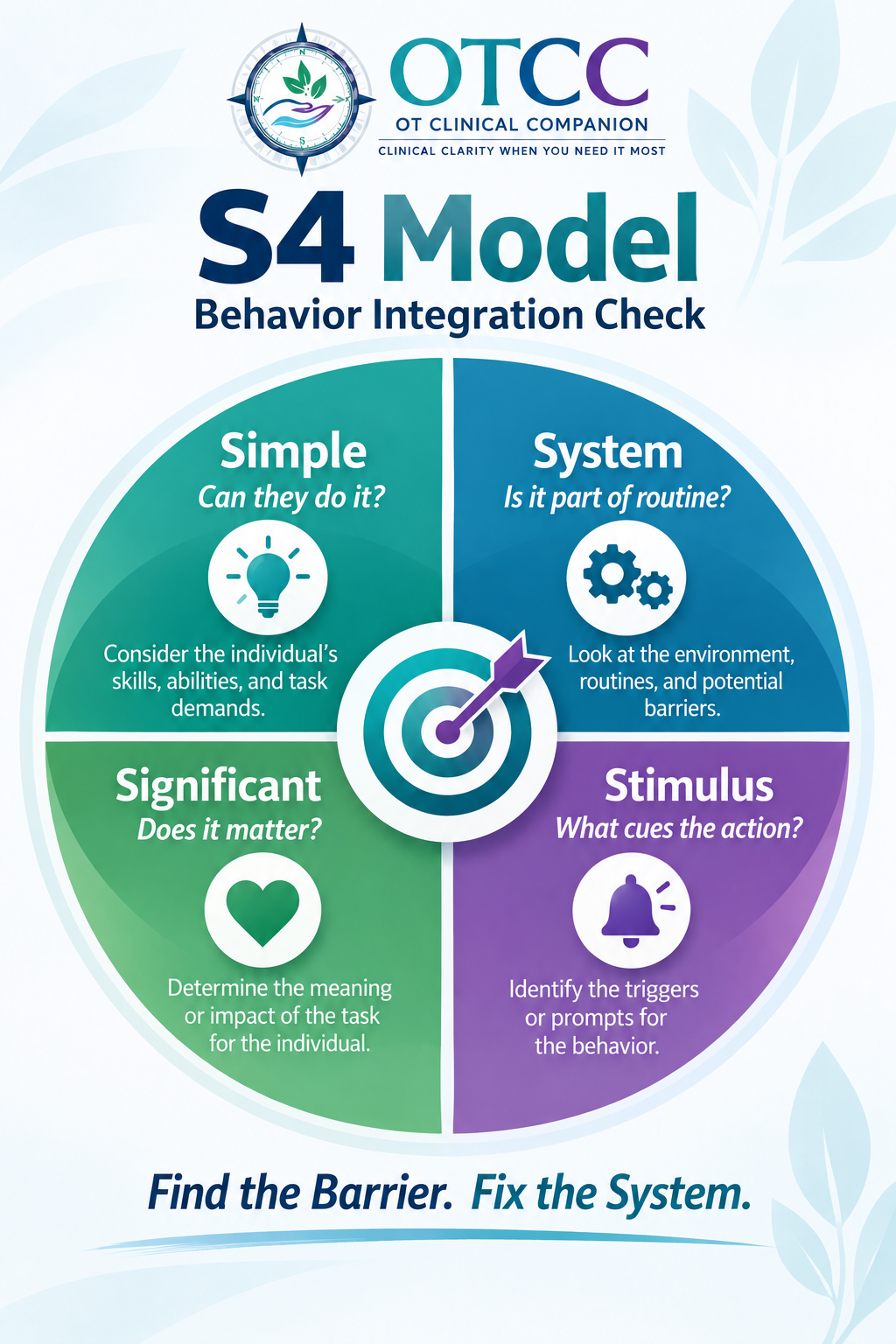
S4 Scan: Behavior Integration Rapid Scan
If intervention adherence barriers are present → run S4 scan.
1. STIMULUS: What triggers the action?
Ask:
What cues this behavior to occur?
Is the environment supporting or interfering?
🚨 Red Flags:
“I forgot”
Task is out of sight, out of mind
Cluttered or undefined spaces
Act:
Add visual/environmental cues (object placement)
Use alarms or reminders
Create dedicated spaces or zones
Reduce competing distractions
2. SIMPLE: Can they realistically do it?
Ask:
Is the task too complex, long, or fatiguing?
Does it require too many steps or decisions?
🚨 Red Flags:
“It’s too much”
Partial completion or avoidance
Visible overwhelm
Act:
Reduce to 1–2 key actions
Shorten duration / reps
Simplify setup or instructions
Introduce adaptive strategies/equipment as needed
3. SYSTEM: Is it built into daily life?
Ask:
When exactly does this happen?
Is it tied to an existing routine?
🚨 Red Flags:
“I’ll do it later”
Inconsistent follow-through
No defined time or context
Act:
Anchor to an existing habit (e.g., after brushing teeth)
Schedule at a consistent time/place
Align with daily rhythms (morning, meals, bedtime)
4. SIGNIFICANT: Does it matter to them?
Ask:
Why does this matter to the client?
Does it connect to their goals, roles, or identity?
🚨 Red Flags:
“I know I should…”
Low engagement or passive agreement
Drop-off when it becomes challenging
Act:
Link to meaningful occupation
Reframe in client-centered language
Revisit and align with occupational profile
⚡ Rule of Thumb: If the behavior isn’t happening, one or more of the 4 S’s is misaligned. (adjust the system, not the expectation)
Clinical Integration
Use during:
Intervention planning
HEP design
Reassessment (lack of progress)
Discharge planning
Evidence & Resources
OT Alignment:
Meaning / motivation: Model of Human Occupation
Habits / routines: MOHO (habituation)
Environment: Person-Environment-Occupation Model
Task grading: Core OT intervention principle
Motivation, ability and prompt: Fogg Behavior Model
Autonomy, competence, relatedness, significance: Self-Determination Theory
Explains readiness stages: Transtheoretical Model
Simplicity reduces cognitive load: Cognitive Load Theory